Pages

Saturday, December 8, 2018

Story of lithotripsy today!


Through years of personal research, and experience of over 18 years in lithotripsy. Every time I read the published article or attend a congress, I go back to my childhood days. The story told by my grandfather refreshes in my mind “the story of blind men and elephant” (link).
Story of lithotripsy is not much different than this story. Physicians are blinded by the lack of knowledge of lithotripsy. They have not put efforts to learn the technique of performing lithotripsy. They all accept HM3 as gold standard treatment, and later compare the result of todays lithotripter with HM3 without learning the technique and putting efforts to learn and master the technique. They have put all their efforts to master invasive procedures, if 50% of time was invested in learning the technique, today lithotripsy would have been on much higher level. Without learning the technique they speak out loud. Its old technology, it’s not efficient, it is not better than FURS(RIRS) or mini-perc, fragments are large, it leaves back residual stones. These statements are no different than the shout of the man in story who gave conclusion without having holistic approach to see big picture.
Not all shockwaves created by different technologies are same. Hence we see strong variation in results 25% to 90% on literature search


Tuesday, December 4, 2018

Not all shockwaves created by different lithotripters are equal

Shockwave lithotripsy revolutionized the treatment of kidney stones in the early 1980s – representing a huge leap in advancement of technology; from open surgical techniques to non-invasive ones.

Physicians took to the leap in technology with enthusiasm, and patients reaped the benefits. Over the years, systems became more user friendly, but also varied in key aspects.

The methods used to generate shockwaves were different – each method of shockwave generation having it’s own unique characteristics.

Developments in imaging modality in x-rays and ultrasound also provided a difference, with modern ultrasound providing better specificity and sensitivity than earlier versions.

The independent development of modern shockwave and imaging technology in certain devices has led to a variation of results in ESWL, depending on the specific device.

As such – “Not all shockwaves created by different lithotripters are equal”, as differences in shockwave generation and imaging modality are factors which influence treatment outcomes.

When evaluating Lithotripsy methods, physicians should bear this in mind – especially when comparing results of endourology with shockwave lithotripsy.

For further insight and perspective, it is recommended that ESWL and other methods of lithotripsy be classified further.

To remain truly unbiased, we recommend the following key factors should be highlighted in published articles (both for and against ESWL):

  1. Shockwave generator technology
  2. Imaging modality used
  3. Energy delivered
  4. Frequency of shockwaves

Tuesday, September 15, 2015

Article on comparison of ESWL (Siemens Lithostar) with Flexible uretreoscopy (RIRS).


Abstract

To compare the outcomes of flexible ureterorenoscopy (F-URS) with extracorporeal shock wave lithotripsy (ESWL) for the treatment of upper or mid calyx kidney stones of 10 to 20 mm.
A total of 174 patients with radioopaque solitary upper or mid calyx stones who underwent ESWL or F-URS with holmium:YAG laser were enrolled in this study. Each group treated with ESWL and F-URS for upper or mid calyx kidney stones were retrospectively compared in terms of retreatment and stone free rates, and complications.
87% (n = 94) of patients who underwent ESWL therapy was stone free at the end of 3rd month. This rate was 92% (n = 61) for patients of F-URS group (p = 0.270 p > 0.05). Retreatment was required in 12.9% of patients (n = 14) who underwent ESWL and these patients were referred to F-URS procedure after 3rd month radiologic investigations. The retreatment rate of cases who were operated with F-URS was 7.5% (n = 5) (p = 0.270 p > 0.05). Ureteral perforation (Clavien grade 3B) was occured in 3 patients (4.5%) who underwent F-URS. Fever (Clavien grade 1) was noted in 7 and 5 patients from ESWL and F-URS group, respectively (6.4% vs 7.5%) (p = 0.78 p > 0.05).
F-URS and ESWL have similar outcomes for the treatment of upper or mid calyx renal stones of 10–20 mm. ESWL has the superiority of minimal invasiveness and avoiding of general anethesia. F-URS should be kept as the second teratment alternative for patients with upper or mid caliceal stones of 10–20 mm and reserved for cases with failure in ESWL.

Tuesday, July 21, 2015

Classification of Lithotripter

we started first lithotripter with energy produced using under water spark gap.
In modern lithotripters  water tub is been replaced by the therapy head balloon enclosing the energy source. Based on technologies available today I have made my own classification of lithotripters. I have reviewed many medical literature in past few decades newer technologies have emerged. This new technologies cannot be generalised they have their own identity and specificity. Hence I have prepared my own classification of lithotripters hope you agree to it.

Thursday, February 27, 2014

Retrograde Intrarenal Surgery (RIRS) vs Extra Corporeal Shockwave Lithotripsy (ESWL)


Today we see lots of debate in the conference and seminar may be one of the most discussed topic on treating kidney stone with RIRS (fURS) vs. ESWL or mini-PCNL vs. RIRS (fURS). However at any point during the debate there is no emphasis on the technology by which shockwave is produced Electrohydraulic (EH) / Electromagnetic (EM) (most common technology of shockwave generation with few piezoelectric lithotripters). Since the maximum installations are of EH, they are cheaper than EM lithotripsy system. EH lithotripter have major market share.
It is not fair to compare RIRS with EH lithotripter. A fair trial would be to compare RIRS with USG guided ESWL on EM lithotripsy system. Today with such advancement in shockwave technology and better understanding of physics of stone fragmentation we fail to deliver results like HM3. One of the prime reason is we have left the therapeutic application in hands of Technicians and fail to take efforts to learn lithotripsy technology.
After all said we compare results of ESWL done by a technician or junior most residents. Technicians and junior residents who probably have never received any formal training on lithotripsy, they have learned on his own by trial and error basis to the results of RIRS which is done by a Surgeon and who has put his efforts to learn RIRS. A well trained and groomed Lithotripsy Technician will always deliver better results doing ultrasound guided ESWL on EM lithotripter when compared to RIRS with much lesser morbidity and financial burden on then patient and to the healthcare insurance provider.

Friday, February 21, 2014

Medical Shockwave was introduced long before it was used to treat stone disease. First Use of Shockwave Not many people know of..........

A patent application for the first shock wave generator to be used for the treatment of brain tumours was filed in the United States by F. Rieber as long ago as 1947. (click here to read more)


It started with soft tissue therapy and all the I need to say that today majority of the development and applications are in field of Shockwave Therapy.

Wednesday, January 1, 2014

USG guided SWL


Ultrasound guided SWL for lower ureteric calculus. 35 years old patient presented with dysuria. On investigation was diagnosed to have 24 mm right lower ureteric calculus.
Patient was treated with USG guided SWL. patient was given total of 3500 shockwaves under USG guidance.
Post SWL patient passed all the calculus fragments in 48 hours.

Wednesday, October 16, 2013

Treatment of kidney stone

All kidney stone below 20 mm can be treated with lithotripsy provided anatomy is favorable.

Investigation required prior to lithotripsy
1) Intravenous pyelography or CT Urography.
2) Urine culture and sensitivity.
3) Coagulation profile.

Results depends on type of lithotripay machine hence system should meeting following points.

1) Electromagnetic lithotripsy system.
2) Large focal zone (focal zone is area where energy ia delived)
-"IT IS MYTH THAT LARGE FOCAL CAUSES RENAL DAMAGE, IN FACT NARROW FOCAL ZONE MACHINE CAUSES MORE RENAL DAMAGE"
3) Dynamic viewing that is Ultrasound as imaging modality.
4) Energy ramping where sufficient number of energy level stepa are available to fragment stone.

If above this are fullfilled you stone is will definitely be cleared.

"IT IS NOT ONLY DOCTOR BUT SYSTEM COMTRIBUTES TO 75% When lithotripsy is advised. "

Tuesday, September 24, 2013

Inside Kidney Stone Disease

Treating Upper pole calculus with lithotripsy


If you come across a stone in Upper pole with rib overlying the stone. How will you treat such stones with lithotripsy? what to direct shockwave without damaging rib?
9 out of 10 Urologist would fail in such cases.
Some special skills are required how to do that. watch out.

Wednesday, April 3, 2013

Approach to treat ureteic calculus.

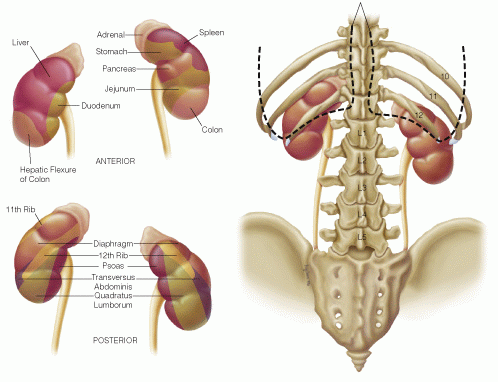
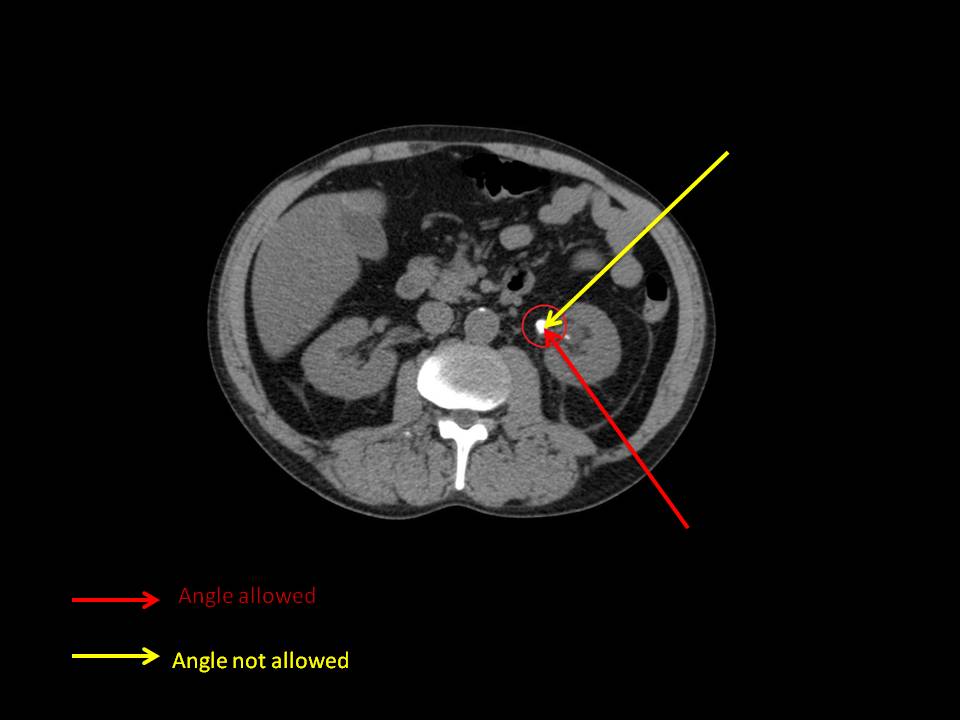
Direction of shockwave entry is most important as far as results and injury to the organ is concerned.
According to me the best direction to treat the Urinary stone disease is retroperitoneal (Posterior) approach for renal and upper ureteic calculus.
As illustrated in the diagram if we have anterior or transperitoneal (Anteriror) approach for ureteric calculus changes of intestinal injury is high. Ureter being retroperitoneal organ, its advisable that shockwave axis is retroperitoneal and not laterally or anteriorly.

Second energy and frequecy for ureteric stone is high, which can lead to more damage to abdominal organ in anterior approach of shockwave.

"ALWAYS USE POSTERIOR APPROACH IF YOU ARE TREATING URETERIC CALCULUS."


Saturday, March 2, 2013

Lithotripsy for pancreatic calculus

It is surprising that when it comes to gastrointestinal calculus lithotripsy there is no emphasis on technology and physics its all about blindly following what some people are doing. Need to educate gastrointestinal surgeons regarding physics of Lithotripsy so that they are better position to adapted new technology and other systems

Master of Lithotripsy (ESWL) and ESWT http://mastersoflithotripsy.blogspot.com/

Saturday, February 23, 2013

Is lithotripsy a dying art?

Many people feel that lithotripsy is dying as RIRS is taking over. I have discussed with leading urologist across India of record they have to say lithotrispy can never die, in fact RIRS will come to end soon. Some of them had to say after HoLEP has come to market have TURP died no TURP is still Gold standard similarly ESWL cannot die its has got its own standards.

Master of Lithotripsy (ESWL) and ESWT http://mastersoflithotripsy.blogspot.com/

Sunday, April 22, 2012

How much jelly to apply during ESWL has always been a issue. There are guilde lines available regarding 1) Type of jelly to be used. 2) Amount of jelly to be used. 3) How to apply the jelly over therapy head. If we follow the protocol the the results would be excellent!!!!!

Back after long time with some good news!!!!

Hi all sorry wa away from the blog since some time infact long time. Actually I was busy creating the history. I had 2 priorty dreams professionally and yesterday I got some good positive feedback for my dream. And now I am very close to my dream!!!!!! There has been some remarkable experience over last few months. Will come over in next few weeks (not months like this time).